You have already made your way through blonde leaf tobacco, your nicotine tolerance has gone up, and you are starting to feel a little too easy. You are ready! The world of much-praised dark leaf tobacco is opening up in front of you. It brings new challenges, different techniques, plenty of great flavours, but also a few traps. I am here to teach you how to work with dark leaf and understand it better. Shall we get into it?
Dark leaf tobacco has a certain reputation, at least judging by the messages I get from many hookah smokers. “I do not dare try dark leaf. It is too strong for me, I can taste the tobacco. Every time I tried dark leaf, it sent me straight to hell. People say dark leaf can be prepared in a way that almost anyone can handle - is that true?” Yes! This article is not only for beginners and blonde leaf smokers, but also for practising dark-leaf wizards, because sometimes we are all a little lost in dark tobacco. So let’s take the mask off this dark little monster.
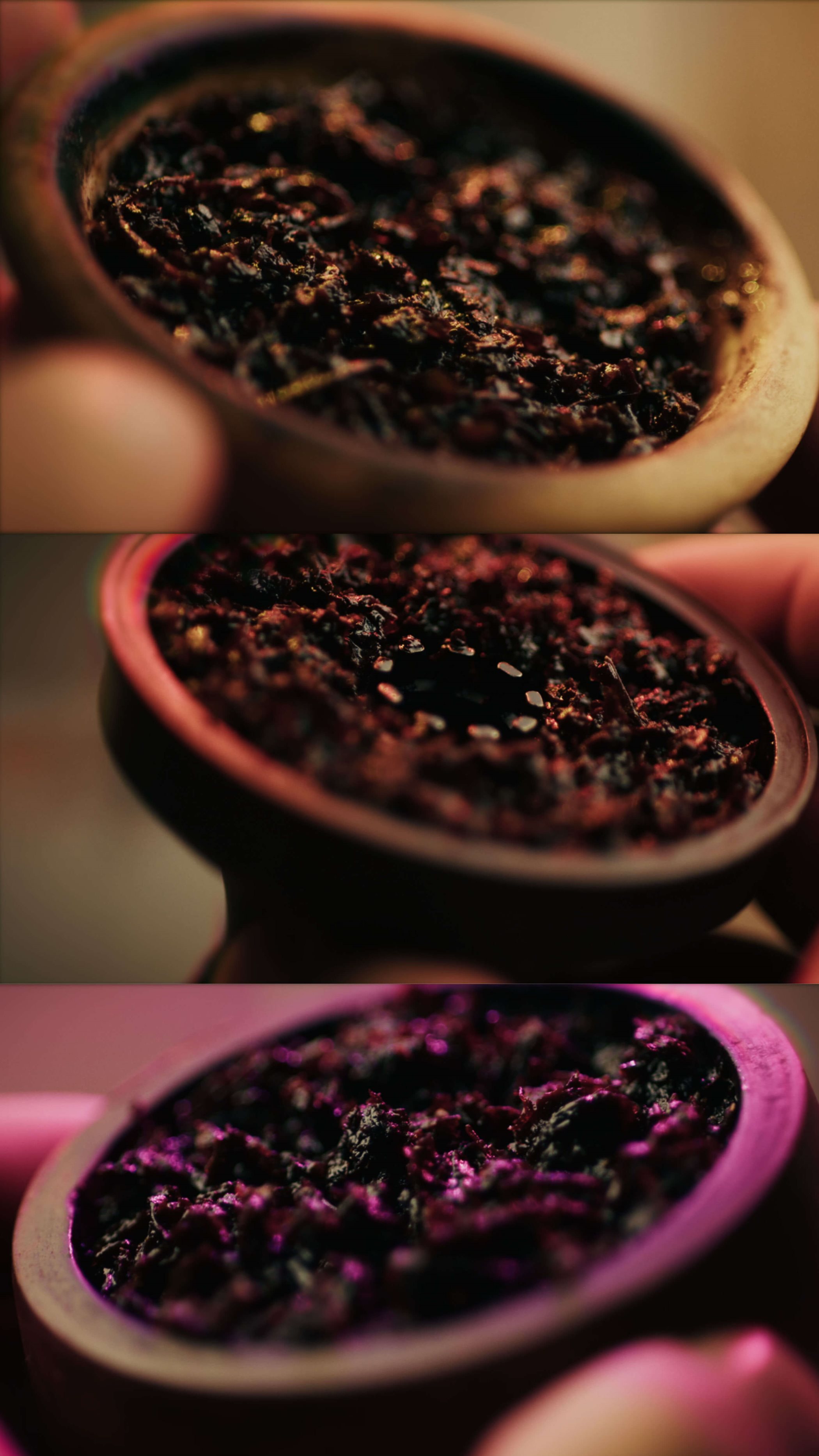
Into the Dark Kingdom
Dark tobacco, black tobacco, dark leaf, or dark leaf tobacco. A relatively “new” thing that was created by Eric Hoffman back in 1999 and went on sale in 2005 — we are talking about Tangiers. The eastern dark wave started in 2013, with DARKSIDE and other brands gradually appearing. Many people also consider classic unflavoured muʽassel to be dark leaf, such as the legendary Nakhla Zaghloul, which dates back to the beginning of the 20th century. To close this little history window: in the Czech Republic, we officially encountered dark leaf in the form of Doobacco in 2013, and by the end of the decade there were only a few legal brands on the market, but a huge selection from smugglers. Today the situation is completely different, and thanks to the Great Lizard for that.
Dark leaf tobacco is not just about strength. It is a complex combination of flavour, aroma, the taste of the tobacco leaf itself, and a higher nicotine content. It is not suitable for complete beginners; work your way up to it gradually. This is also possible thanks to different strength lines offered by many dark leaf brands, so it can be enjoyed by a more resistant rookie, an advanced smoker, and a hookah enthusiast with a serious nicotine appetite. Expect the tobacco leaf taste to be present in the flavour to a greater or lesser extent. It may put some people off, but give it a chance — you may fall in love with it.
Properties, Strength, and Composition
Dark leaf tobacco is primarily made from Burley leaves, as well as blends of Burley with Virginia and Oriental, and increasingly also processed cigar leaves. The leaves are fermented, boiled, pressure-roasted, and modified in different ways to reduce bitterness, create a stronger aroma, and improve their properties. Burley is usually not washed, so it keeps a higher amount of nicotine, although washing is also used to achieve a “weaker dark leaf”. In terms of nicotine, its share in relation to the rest of the mixture ranges from 0.15 to 0.7%, while blonde tobacco ranges from 0.02 to 0.1%. Just an interesting note.
Let’s divide the dark leaf available on our market. Among the weaker dark leaf tobaccos, which are an ideal transition for blonde leaf smokers, I would include Blaze, Craftium and Theo. Medium-strength dark leaf tobaccos will satisfy most of the community, and this group includes Azure, BlackBurn, DARKSIDE, Khan Burley and Starbuzz Vintage. The imaginary peak of strength is ruled by TNG Alpaca / Tangiers.
The molasses, or sugar syrup, is usually black, sometimes dark brown. Sometimes the tobacco is swimming in it, as with DARKSIDE or Starbuzz Vintage, and other times you practically need a magnifying glass to find it, as with TNG Alpaca. You may also come across a sticky, jam-like consistency. The leaf size ranges from fine to medium, although you may occasionally pull out a proper bat wing. You can also find stems in the mix - thin ones are fine, but thick sticks should be removed or cut into smaller pieces.
It can reliably last two hours in a bowl, with 13 g or more, and with a proper amount of tobacco and good coal service, it can even push hookah records in the form of several-hour sessions. Of course, this is not a fixed rule. It depends on the brand, packing style, amount of tobacco, your preferences, and so on. Dark leaf has average to excellent heat resistance. Many dark tobaccos need a serious amount of heat to work properly and fully open up their flavour. If you do not give dark leaf enough heat, it can become unstable, sharp, scratchy in the throat, heavy, and so on. Paradoxically, the same can happen when you give it too much heat. It is a bit of a science, but sooner or later you will get it under control.
For a smoother dark leaf session, foil works very well. With an HMD (Heat management system), the flavour becomes more intense and more pronounced. Most brands can handle a contact pack, and for hookah smokers looking for intensity, packing dark leaf with contact is the number one choice.
Preparing the Tobacco
Store your tobacco in a dark place at room temperature, away from direct sunlight - no fridge! If it is in a pouch, massage it properly before opening so the molasses mixes thoroughly with the tobacco. For the same reason, stir tobacco in a jar or tub before packing. If you come across really huge leaves, also known as a coarse cut, you can trim them with scissors. The cut will become smaller, the tobacco will be easier to work with, and it will gain more volume.
If the tobacco smells strange or directly attacks your nose and throat, try acclimating it. Transfer it from the pouch into a tub, jar, or another container, mix it thoroughly, and leave it open for 24 hours to air out. Stir it from time to time. Once the tobacco smells pleasantly strong to you, or finally smells like the flavour stated on the packaging, you can smoke it.
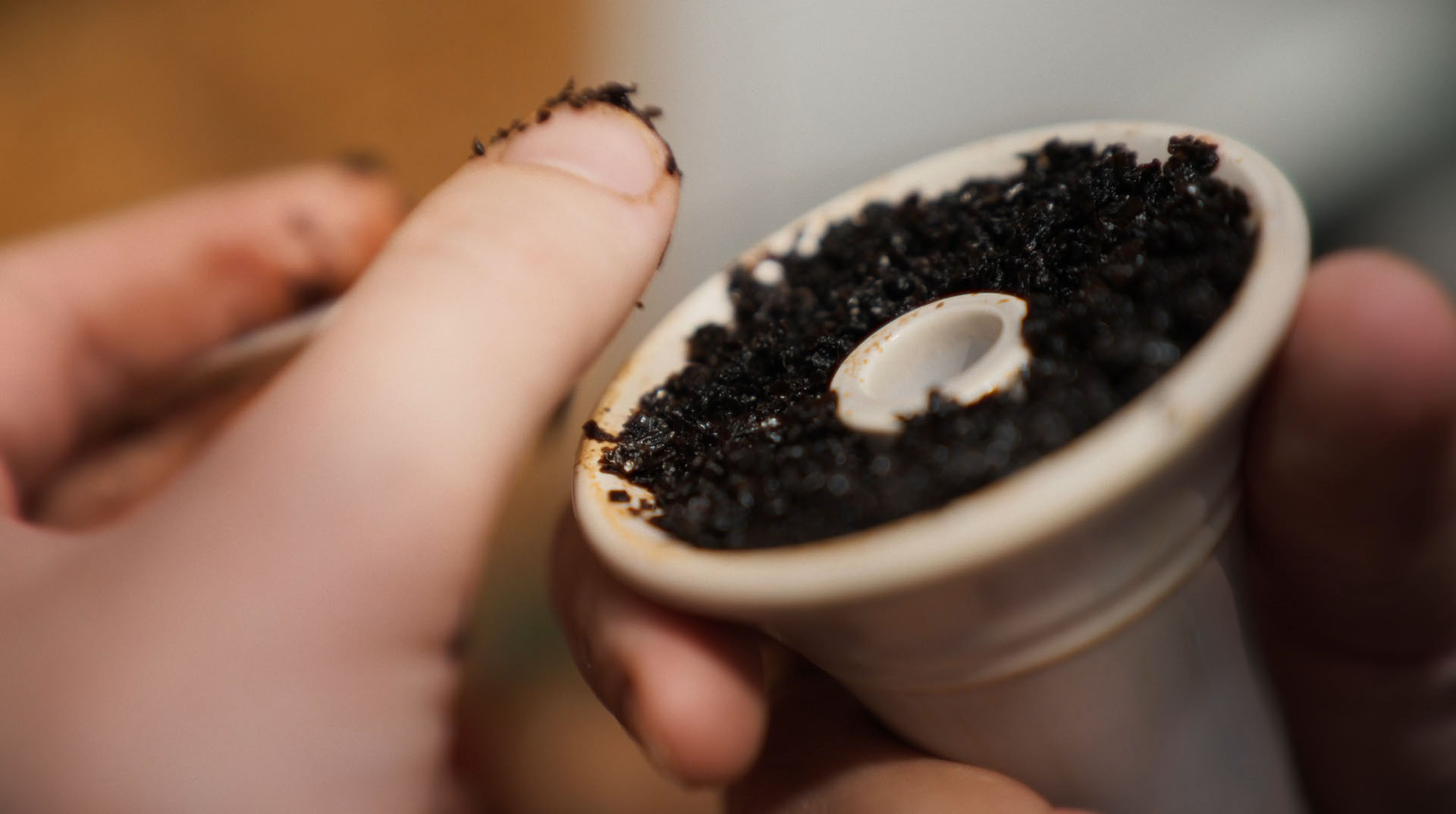
How much tobacco should you use? That depends on the expected length of your session. For a short one-hour session, pack 8–12 g. For up to two hours, 15–20 g should be enough. Those imaginary record sessions will take around 20–40 g of tobacco. Do you not have a scale? It is not essential. Over time, you will learn to judge the amount by the size of the tobacco clump. For now, you can measure it directly with the bowl.
Choosing the Right Bowl
When talking about the hookah bowl and the amount of tobacco, think again about how long you want to smoke. This will tell you whether to go for a shallow, medium, or deep bowl. If you overpack a shallow bowl, or put a tiny amount of tobacco into a deep tobacco-hungry bowl, neither option will give you a great session. Dark leaf tobacco works in both traditional bowls and phunnels.
A traditional Turkish-style bowl should have medium to thick walls. Thin-walled bowls transfer heat to the tobacco from the sides very quickly - a clear choice for an intense session, but with an impact on longevity. This type of bowl is suitable for drier to moist tobaccos. Tobacco that is drowned in molasses will drip into the base, colour the water, and degrade the flavour. That is simply due to the construction of a traditional bowl. You can still smoke dark leaf from them without any problem, and many people do not mind coloured water. You can avoid it by using a molasses catcher or by lightly drying the mixture with a paper towel. Do not squeeze the molasses out of the tobacco!
An unglazed version partly absorbs and distributes heat, while traditional bowls glazed inside the bowl reflect heat back into the tobacco. This gives dark leaf more heat faster, if that is what you want. I recommend a rounded, bowl-shaped bottom for a light to medium session. A traditional bowl with a flat bottom, such as Evil or Killer-style bowls, heats the tobacco more efficiently and gives you a more intense experience.
Phunnels keep the molasses in the tobacco and give it less heat, which together with dark leaf can create a smooth, relaxed, flavour-focused session without a nicotine storm. In a traditional bowl, dark leaf is usually more intense. In a phunnel, it is milder. For dark-leaf wizards in training, I recommend starting with a phunnel.
Foil or HMD?
Let’s keep it simple. Foil gives consistently good results with dark leaf tobacco. The flavour delivery is smooth, there is plenty of smoke, and it can even tickle you with strength more than an HMD (Heat management). It uses zone heating - the most heat is where the coals sit - or, with accessories, more even heating. Use one layer of hookah foil and give it a chance, even if you are an experienced dark leaf smoker.
The downsides? You need to know how to prepare a foil setup properly. It requires active work with the coals and their position on the bowl. With one round of coals, you will also usually get a shorter session than with an HMD, because the coals burn hotter and faster and there is less heat retention.
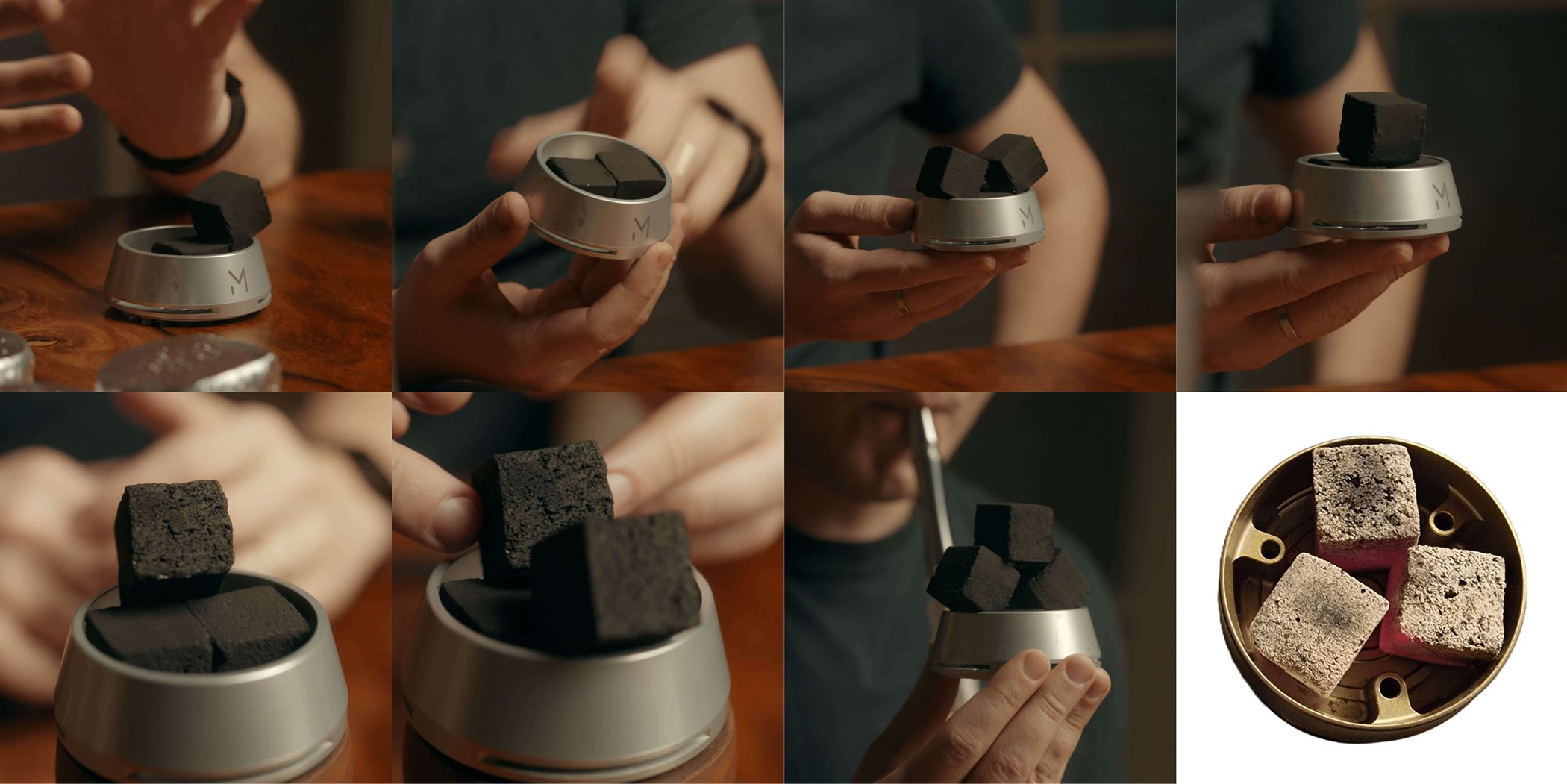
Arguments for an HMD? Thanks to different coal positions inside the device, you can choose whether to go for low heat, which gives smoothness, lower intensity, and longer longevity, or high heat, which gives higher intensity but also brings a higher risk of overheating and shorter longevity. You will definitely get a longer session thanks to heat retention and even heating. In general, you can achieve a more intense flavour than with foil. It is also easier to use, with no need to stretch foil or punch holes. No ash in the bowl either.
Packing Tips
If you pack with your hands, wash them first. Learn to use one hand for packing and the other for handling the bowl, poker, and so on. When packing, first look at the bowl from above and spread the layer of tobacco evenly. Then lift the bowl, rotate it, and check it from the sides. This way, you will see any uneven spots, holes, or tobacco hanging over the edge. Adjust the tobacco, add or remove a leaf, and level the surface.
Finally, look across the rim of the bowl. Want to pack without contact? Gently push any sticking-out leaves below the rim of the bowl. Packing with contact? Adjust the leaves so they extend evenly over the rim.
Packing Dark Leaf Tobacco
I am a dark leaf smoker who feels most at home in the area of smooth to medium sessions. I use small and medium HMDs as well as foil. I most often smoke from traditional bowls. I pack with contact only rarely. My sessions last around two hours, give or take. That is me. You may have a completely different idea of the ideal session, so take this as inspiration and my personal view on the matter.
In general, based on my practice, I look at everyday dark leaf packing like this:
- Low intensity “for flavour”: a thick-walled traditional bowl or an unglazed bowl-shaped phunnel, fluffy pack and spread the tobacco evenly, no contact, heat up with 3 coals in a pyramid in the HMD, smoke with 2 coals.
- Medium intensity “comfortable middle ground”: a traditional bowl with medium walls or a glazed phunnel with slanted walls or a flat bottom, fluffy pack and lightly press the top layer, optional, no contact with a smaller gap or light contact, heat up with 4 coals, 2 inside and 2 leaning against the wall of the HMD, smoke with 3 coals in a pyramid.
- High intensity “for strength”: a flat-bottom traditional bowl, such as killer or evil types, or a bowl with thinner walls. Pack it with a fork and shape it so it is compact, but not packed down like it was hit with a shovel. Pack with light contact up to full contact, for about an hour and a half maximum. With both HMD and foil, heat up with 4 coals and smoke with 3 in a pyramid on a small or medium HMD. For true enthusiasts, use 3 coals inside a larger HMD. With foil, continue with 3 coals.
Dark Leaf Tobacco in a Traditional Bowl
Let’s leave the preheating technique aside for now, as well as special packs designed to maximize strength for a few dozen minutes, such as the Kazan grenade, Russian flower, and so on. You have several options to choose from.
The simple packing method is the fluffy pack technique - in Czech we usually say “nadrobit”, meaning to sprinkle the tobacco loosely. Dark leaf tobacco prepared this way in the bowl will be flavour-intense, give you rich smoke, and deliver a solid dose of nicotine, depending on the brand. It is not suitable for very dry tobaccos, as they will start burning quickly. Heat flows easily through loosely sprinkled tobacco and heats all the layers.
But what if you do not want to push that much heat into the tobacco, or you want it to release gradually? You need to press it down a little. In the American packing style, this is called a normal pack or semi-dense pack. I personally use a slightly different version, but for now we will follow the original idea. Proceed exactly the same way as with a fluffy pack, with one difference: gently press down the top layer of tobacco. The bottom layer stays fluffy, while the top layer is lightly compressed and more compact.
Heat will not pass through the top layer as easily, which protects most of the mix from a heavy heat load. The result is a session without major heat-resistance issues. Heating is gradual, there is plenty of smoke, and the session starts with a strong flavour that slowly moves into a balanced middle phase. For better heating, you can also pull the tobacco slightly away from the walls and more toward the centre. Any heavier compression of tobacco in a traditional bowl will clog the holes and dramatically worsen airflow. It works in phunnels, which you will understand in a moment.
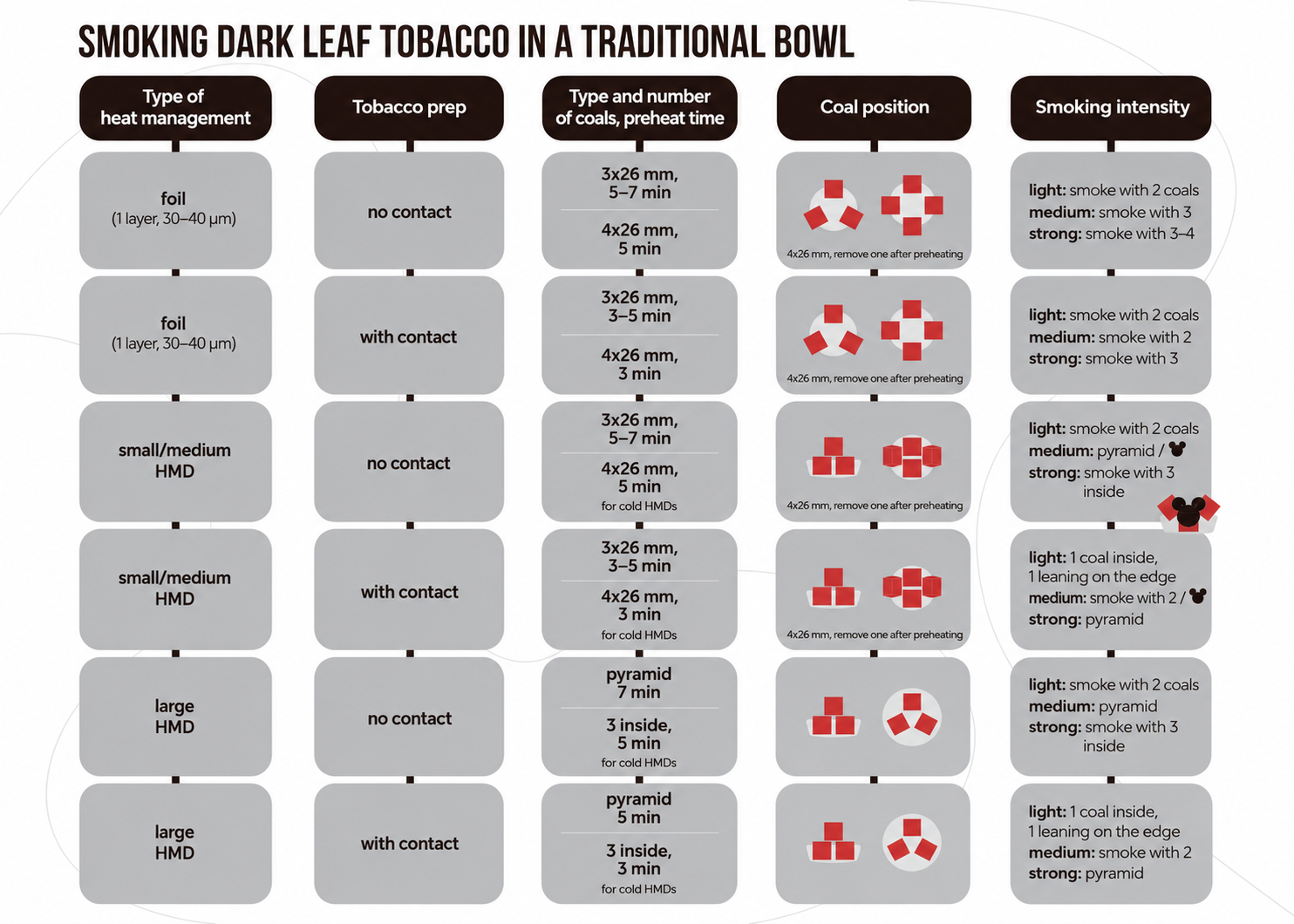
I have created a little cheat sheet for you. I will add that it is based on my own practice, and you can calmly say to yourself that you would do it differently. Take it as inspiration.
Packing Dark Leaf Tobacco in a Phunnel
A phunnel is a popular destination for dark leaf tobacco, provided you are aiming for a smooth, flavour-focused session. Americans and Germans often like to pack it with a fork. Never cover the centre spire with tobacco - it must always stay open.
If your goal is a very smooth flavour, use the fluffy pack method again and pack without contact. Sometimes, however, you may have trouble getting enough heat into the tobacco. A stronger flavour and more stable heating can paradoxically be achieved by compressing the tobacco more. Whether with your fingers or a fork, load the tobacco into the bowl. Shape it into a uniform layer; for a dense pack, you can press it down properly. This works great with the foil setup mentioned earlier. It works without contact, and a few points of contact with the HMD or foil are also suitable so that the more compact layer of tobacco heats more effectively. For better heating, you can also pull the tobacco slightly away from the walls and more toward the centre.
Did someone say cheat sheet?
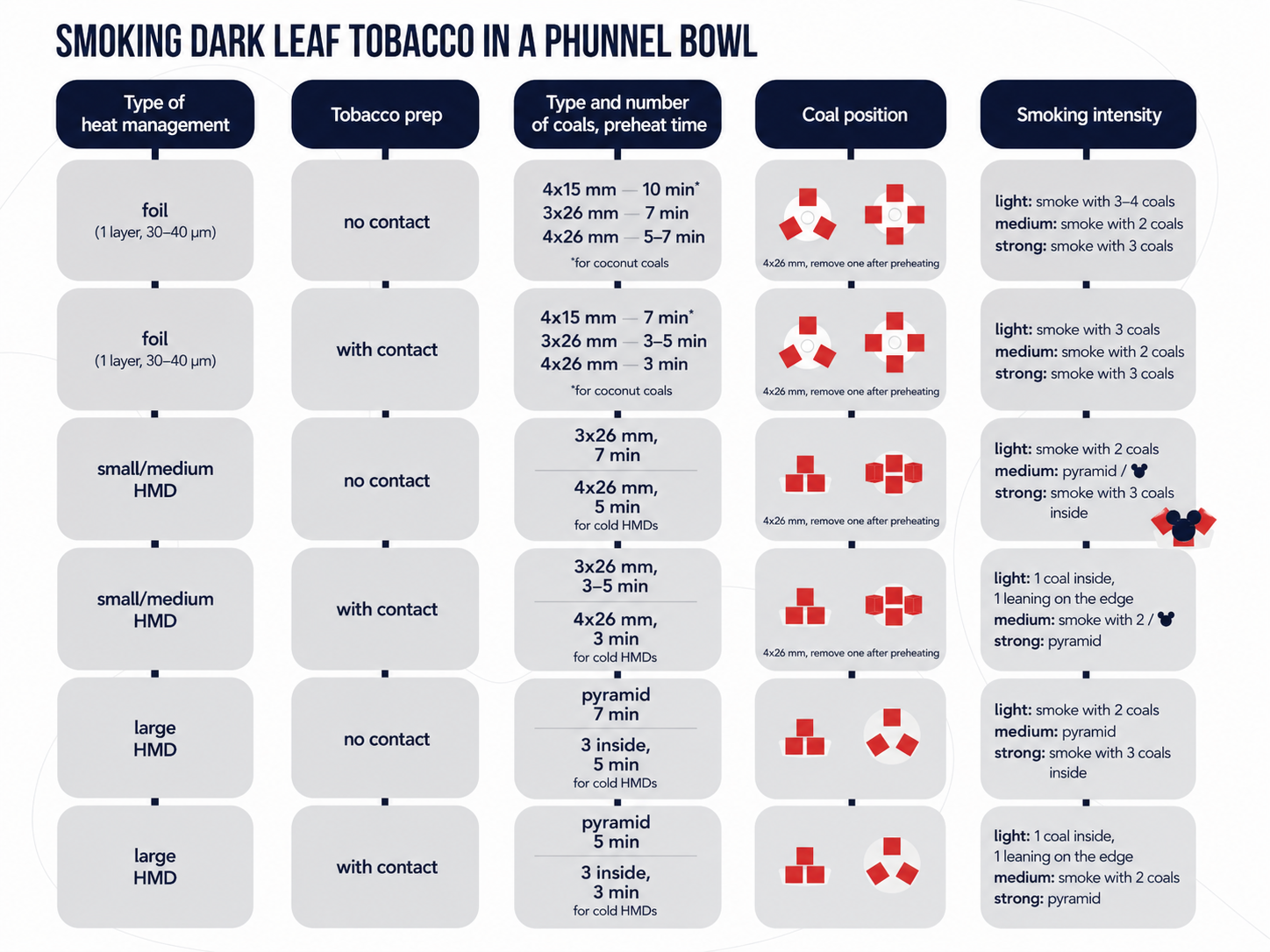
With Contact or Without?
That brings us to gaps and contact. For a traditional bowl, I recommend packing without contact between the tobacco and the HMD or foil. Make sure there is about a 3–5 mm gap between the rim of the bowl and the tobacco. This will give you rich flavour, dense smoke, and good nicotine distribution. In a phunnel, a few tobacco leaves touching the HMD or foil will help heat the whole mix. Try both contact and no-contact packs in a phunnel and see what suits you best.
A contact pack under foil uses more tobacco, because there are no HMD ridges touching the tobacco inside the bowl. In general, a contact pack provides direct heating of the mix, more intense flavour and smoke, but also a higher risk of overheating. It is more demanding in terms of heat control. Do not take long breaks between pulls, otherwise the stuck leaves may burn.
Heat Management
The strength of a hookah is definitely affected by the tobacco brand, packing style, bowl choice, contact or no-contact setup, and also the amount of heat. This brings us to the question of whether dark leaf can be packed in a way that almost anyone can handle. If we focus mainly on heat, a low amount of heat leads to a smooth flavour, lower intensity, and long longevity. This is ideal for many beginner dark-leaf wizards, but do not forget to heat up the bowl and tobacco properly at the beginning of the session. Otherwise, the tobacco may be aggressive, scratchy in the throat, and so on.
Most of us are looking for that imaginary middle ground, a balance between intensity and longevity. Nicotine lovers can get the maximum out of the tobacco with a heavy heat load, but with an impact on longevity - the faster you vaporize those substances, the shorter the session you get.
Only active coal management throughout the session will give you a long-lasting, quality hookah. If you follow this, one round of coals will be enough even for a two-hour session. Ash your coals, rotate them, move them around, and do not leave them sitting unused for too long.
What should you do with a hookah coal that has been set aside? The longer you leave it on the tray or in the coal carrier, the faster it will shrink. And when you finally use it, it will be a third of the size of the coals that stayed in use. Rotate the active and set-aside coals among each other so they stay the same size throughout the session. Do this every 20 minutes, or extend or shorten the interval as needed. Toward the end of the session, or whenever necessary, gradually use all the remaining active coals.
Conclusion
Remember that the packing technique, bowl choice, contact or no-contact setup, heat management, and use of foil or an HMD all depend entirely on your idea of the perfect hookah session — its longevity, flavour delivery, and overall feel. Think about what kind of dark leaf session you want, and thanks to the information in this article, it should now be clearer which technique and accessories to use.
There are plenty of reasons why you may not enjoy your bowl of dark leaf in the end. It is not only about packing techniques. If you are curious and want to learn as much as possible about hookah practice, I have a whole series of articles and videos for you that reveal all the details: heat management, the correct pulling style, common mistakes in preparation and smoking, and much more.



 Kaloud
 KLIFIDES
 marvin smoke
 DARKSIDE


