In November, when darkness falls before five in the afternoon across much of Europe, India lights up millions of small oil lamps. Diwali, the festival of lights, is to hundreds of millions of people what Christmas is to many of us: a time of cleaning, gifts, family gatherings and light that drives away the dark. Let’s look at what the festival means, how it is celebrated and how you can bring its atmosphere into your own living room – with incense sticks, candles, a statue of Ganesha and a cup of spiced tea.
What Diwali is and when it is celebrated in 2026
Diwali (also Deepavali, from the Sanskrit for “row of lights”) is the biggest festival of the Hindu calendar. It is also celebrated by Jains and Sikhs, and not only in India but in Nepal, Sri Lanka, Mauritius, Malaysia and the British city of Leicester, which hosts one of the largest celebrations outside Asia.
The date follows the lunar calendar, so it moves every year. The main day always falls on the new moon (amavasya) of the month of Kartik – the darkest night of the year. In 2026, the main day of Diwali falls on Sunday, 8 November, and the whole festival lasts five days, from Friday 6 to Tuesday 10 November.
At its heart, Diwali carries a simple idea: light triumphs over darkness, good over evil and knowledge over ignorance. That is why lamps are lit everywhere possible during these days – on doorsteps, in windows, on rooftops and floating on rivers.
The legends behind the festival of lights
Every region of India tells a slightly different story about Diwali. Yet all of them end the same way: darkness gives way to light.
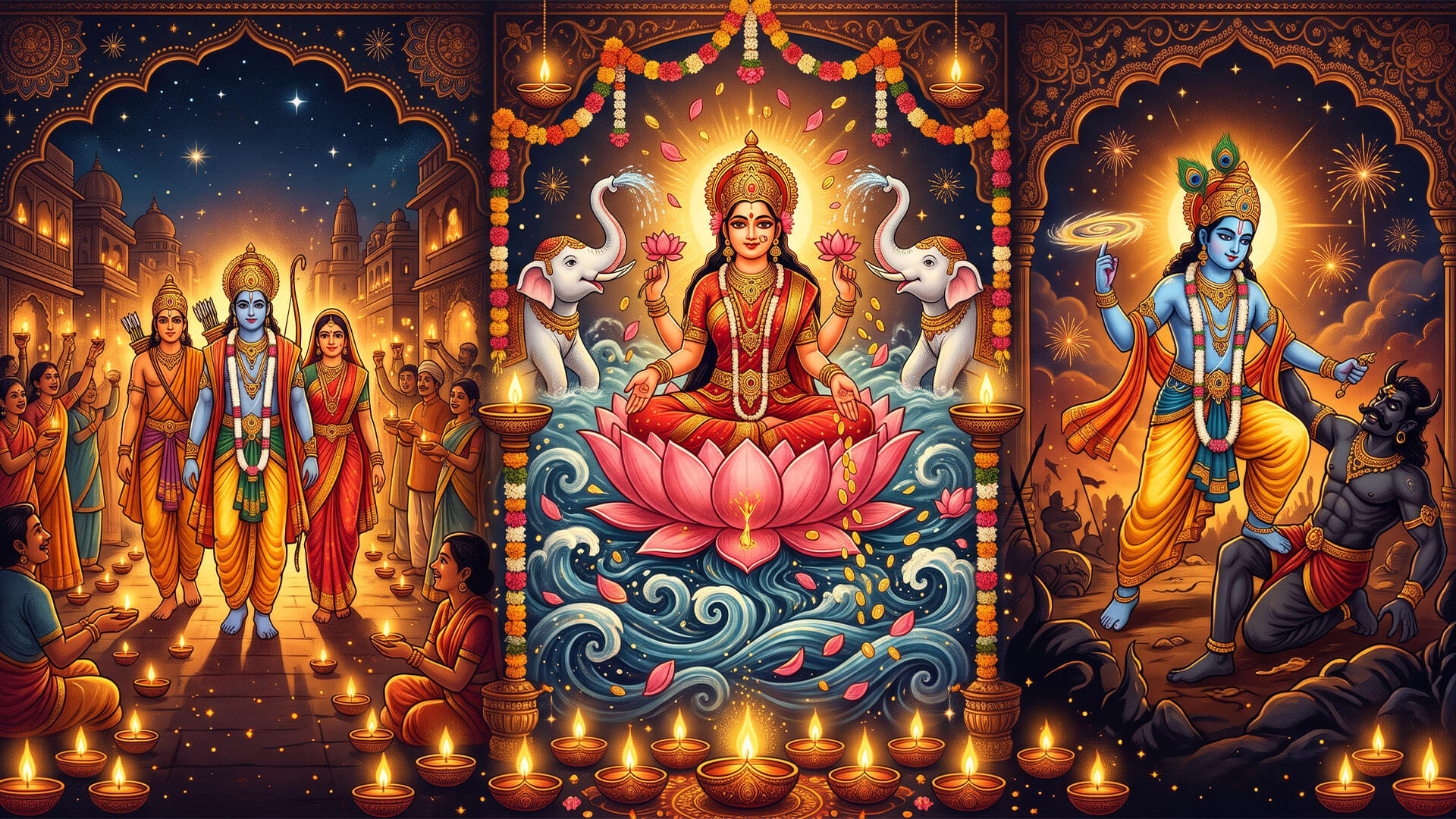
Rama’s return to Ayodhya. The best-known legend comes from the epic Ramayana. After fourteen years of exile and his victory over the demon king Ravana, Prince Rama returns home with his wife Sita and his brother Lakshmana. The people of Ayodhya lit his way through the moonless night with rows of clay lamps – and the lamps have been lit every year since.
The birth of the goddess Lakshmi. According to another tradition, Lakshmi, the goddess of fortune, abundance and prosperity, emerged on this very night from the mythical churning of the ocean of milk. She is believed to walk through homes during Diwali and enter those that are clean, bright and fragrant – which is where the customs of deep cleaning and illuminated doorsteps come from.
Krishna and the demon Naraka. In southern India, people celebrate Krishna’s victory over the demon Narakasura, who held thousands of people captive. The day before the main festival, evil is symbolically “washed away” with a ritual bath in scented oils.
Jains mark Diwali as the day their teacher Mahavira attained nirvana, while Sikhs commemorate the release of Guru Hargobind from prison. Whatever the tradition, Diwali is a festival of renewal – of cleansing the home and the mind, and of new beginnings.
The five days of Diwali
Diwali is not a single evening but a five-day cycle. Each day has its own meaning and rituals.
- Dhanteras (Friday, 6 Nov 2026) – the day of abundance. Homes are cleaned, new metal items, cookware and jewellery are bought, and the first lamp is placed on the doorstep for Yama, the god of death, to protect the family.
- Naraka Chaturdashi / Choti Diwali (Saturday, 7 Nov) – the day of purification. Mornings begin with a bath in oil and herbal pastes; in the evening the first lights are lit and the house is decorated with rangoli patterns.
- Lakshmi Puja / main Diwali (Sunday, 8 Nov) – the high point of the festival. After dark, a ceremony (puja) honours Lakshmi and Ganesha, dozens of lamps, resin incense and incense sticks are lit, and the family shares sweets and exchanges gifts.
- Govardhan Puja / Annakut (Monday, 9 Nov) – a day of gratitude for the harvest and nature. A “mountain of food” made up of dozens of dishes is offered to the gods. In western India, this day marks the start of the new business year.
- Bhai Dooj (Tuesday, 10 Nov) – the festival of siblings. Sisters mark their brothers’ foreheads with a tilak and pray for their health; brothers give them gifts in return.
Light at the heart of the festival: diyas, candles and candle holders
The symbol of Diwali is the diya – a small bowl of baked clay filled with oil or ghee (clarified butter), with a cotton wick. Diyas are placed in odd numbers on doorsteps, in windows, on balconies and next to the home altar. Each little flame invites good fortune in and drives darkness, illness and worry out.
In a European flat, a tealight in a beautiful holder is the easiest stand-in for a diya. The closest to Indian tradition are hand-carved soapstone holders made in India – such as the Noida soapstone candle holder with its flower motif or the Gorakhpur soapstone candle holder on a small base. The stone warms up and the light shines through its fine cut-outs, so even a single candle paints an ornamental shadow on the wall.
To create a more festive focal point by your altar, choose the golden resin Buddha candle holder for two tealights. Gold is Lakshmi’s colour and a symbol of abundance during Diwali. For soft, diffused light, try the Sacred Lotus tealight lantern– the lotus is the flower Lakshmi is traditionally shown sitting on – or the version with the Om mantra.
If you want fragrance as well as light, light the aromatherapy Green Tree Gemstone Good Energy candle with Palo Santoand carnelian crystals. For a balcony, terrace or front door, oriental lampions are a perfect fit – in India, they hang above streets and entrances throughout Diwali. Browse the full range in Candles, candlesticks and lampshades.
Incense and smudging: the fragrance that welcomes Lakshmi
No puja is complete without agarbatti, Indian incense sticks. In Hinduism, fragrance is one of the five basic offerings (alongside light, flowers, food and water), and the smoke is believed to carry prayers upwards. During Diwali, incense is burned both in the morning while cleaning and in the evening during the main ceremony.
For the evening of Lakshmi Puja, the most natural choice is a stick dedicated to the goddess herself. GR HX Blessings Sri Laxmi Indian incense sticks have a fresh floral scent with gently sweet resin and a herbal finish – exactly the kind of “pure” fragrance the goddess is traditionally said to love.
Other scents that belong to Diwali:
- Nag Champa – the iconic fragrance of Indian temples, made from champaka flowers and sandalwood. Go for the classic Satya Nag Champa 40 g, which will last you all five days of the festival.
- Sandalwood – a sacred wood whose paste is also used to make the tilak mark. Try Satya PK Sandal 20 g or Hem HX Precious Chandan. You can read more about this precious wood in our article on sandalwood.
- Saffron – the warm, spicy scent of the most precious Indian spice, whose colour is the colour of Diwali itself. Look for Goloka Masala Saffron 15 g.
- Dhoop – dense sticks without a bamboo core, burned in India to cleanse the home. Panchavati Dhoop Large, made from Himalayan herbs and sandalwood, is a great place to start.
- Oud (agarwood) – the rarest of temple fragrances, perfect for a festive evening. Satya PK Arabian Oudh 15 g has a deep, warm aroma; we wrote about oud in Oud – Gold Among Fragrances.
Always place your sticks in an incense stick holder to catch the ash. For resins and traditional smudging, use censers and incense powders. Not sure where to start? Our guide on how to choose incense sticks will help.
Lakshmi and Ganesha: a home altar for the festival of lights
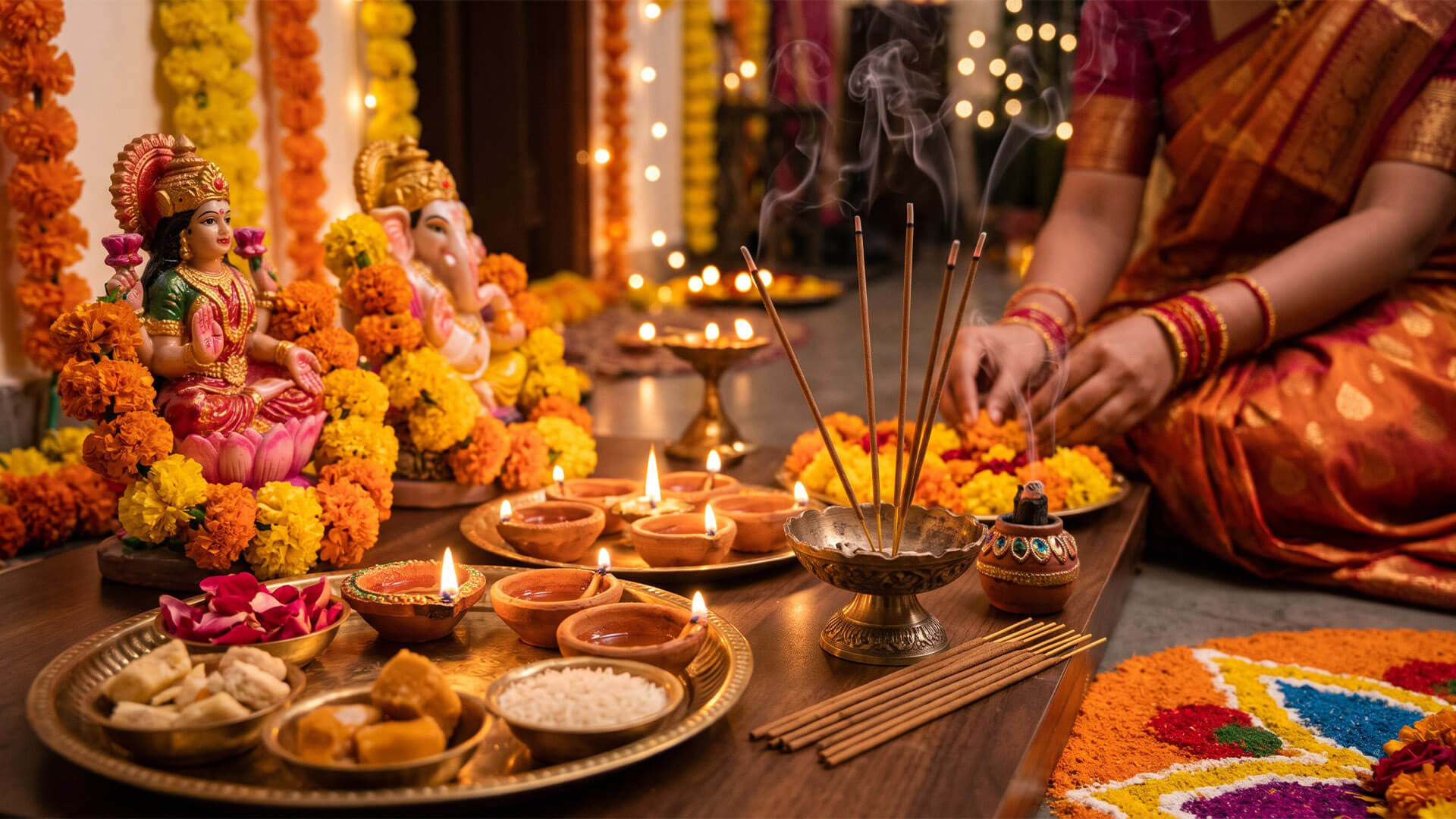
The main evening of Diwali belongs to two deities worshipped together. Lakshmi brings abundance and prosperity; Ganesha, the elephant-headed god, removes obstacles and blesses every new beginning. That is why he is always honoured first in Hinduism – no puja begins without his blessing.
The base of your altar is a clean side table or shelf covered with red or gold fabric. In the centre goes the 16 cm resin Ganesha statuette, compact enough for even a small flat. If you want a bigger focal point, the decorative statues category also offers larger resin, metal and concrete Ganeshas – the concrete ones are ideal for a terrace or garden. Lakshmi can be represented by a picture, a gold coin or a lotus flower – her traditional symbol.
Then add a diya or candle holder, an incense stick, a small bowl of rice, flowers (ideally marigolds or roses) and something sweet. In India, the ceremony opens and closes with the sound of a bell (ghanta), meant to awaken attention and chase away disturbing energies. A hand bell works perfectly, or a Tibetan singing bowl, whose long tone helps calm the mind before meditation.
If you want to carry the energy of Diwali with you after the festival, choose from our amulets and spiritual items – the Om symbol, the lotus or Ganesha are popular talismans for new beginnings and protection.
Rangoli, mandalas and decorating your home
Before Diwali, Indian homes are cleaned even more thoroughly than European ones before Christmas. Lakshmi is believed not to enter a cluttered house – and whatever is no longer needed should leave along with the energy of the old year. Only once the house is clean does the decorating begin.
Rangoli are colourful geometric and floral patterns that women create on doorsteps and floors near the entrance using coloured sand, rice flour or flower petals. They welcome guests and the goddess alike, and their concentric circles echo the mandala. If you don’t feel confident making one, choose a ready-made mandala for the wall by your entrance or above your altar. It works the same way: it draws the eye to the centre and calms the mind.
Above the front door hangs a toran – a garland of orange marigolds and mango leaves that guards the threshold. At home in Europe, a garland of dried flowers will do, or a wind chime, whose gentle sound, according to both feng shui and Indian tradition, stirs up stagnant energy by the entrance.
The colours of Diwali are rich: red, saffron, gold and purple. The quickest way to bring them into your interior is with textiles – an Indian bedspread thrown over the sofa or used as a cloth under your altar transforms a room in a minute. Complete the look with wall decorations and an aroma lamp for warming sandalwood or jasmine oil.
Sweets and masala chai: the taste of Diwali
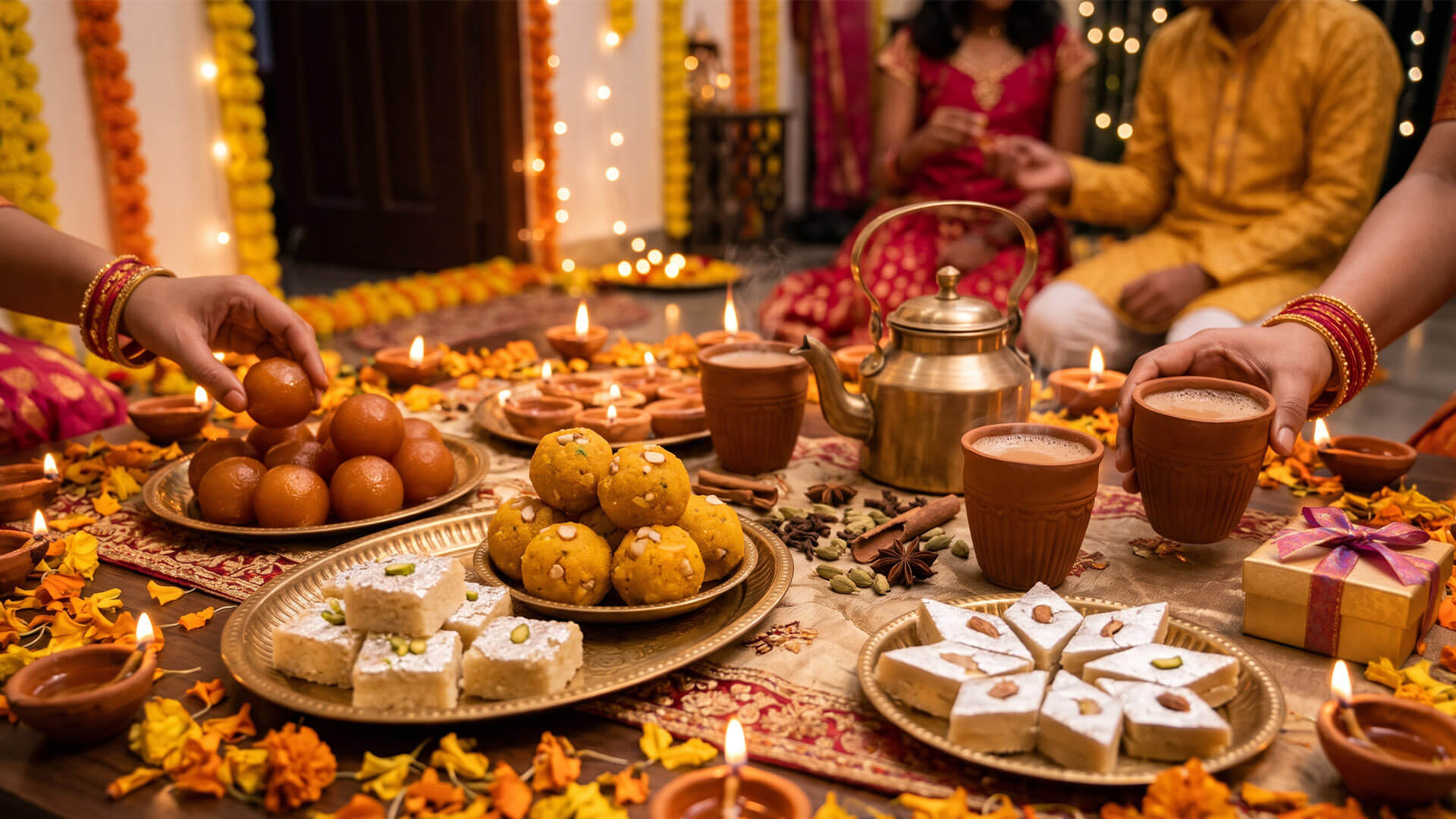
Diwali is a festival of sweets. Families make and buy mithai – coconut barfi, gulab jamun dumplings in syrup or ladoo made from chickpea flour – and boxes of them are handed out to neighbours, colleagues and friends. Sharing something sweet expresses the wish that the new year will be “sweet” too.
In Indian homes, mithai is served with masala chai – black tea simmered with milk and spices. For the most authentic version, use the Data Masala Tea spice blend, made especially for the Indian drink known as yogi tea. Simmer the spices with a strong black tea such as Assam or Ceylon in water with milk for about 10 minutes, strain and sweeten to taste – in India, usually with cane sugar or jaggery. If you like to fine-tune the flavour yourself, add a few crushed cardamom seeds or a stick of whole cinnamon.
You’ll find oriental treats to go with your tea – or to give as small gifts – in our sweets and snacks category, and more spices for your kitchen in the spice section. Serve the chai in small cups – in India it is drunk from clay cups called kulhad – right after the puja, when the family gathers around the table.
How to celebrate Diwali at home: a simple ritual
You don’t need to be Hindu to bring the message of the festival of lights into your home. All it takes is one November evening – ideally Sunday, 8 November 2026, after dark – and a few things you may already have.
- Clean and air the house. The day before, go through your home and let go of what you no longer need. Then smudge the rooms with dhoop or a sandalwood stick and open the windows.
- Prepare the space. Spread a red or gold cloth on a small table and place a Ganesha statuette and a symbol of Lakshmi on it, along with a bowl of rice, flowers and something sweet.
- Light the lamps. After dark, light an odd number of candles – on the altar, in the windows and by the front door. You can link each light to one wish for the year ahead.
- Fragrance and sound. Light a Sri Laxmi or Nag Champa incense stick and open the ceremony by ringing a bell or sounding a Tibetan singing bowl.
- A moment of silence. Sit for a few minutes and simply watch the flames. Give thanks for what the past year has brought you, and silently name what you want to let go of.
- Share. Brew masala chai, share sweets and give your loved ones a small gift – incense sticks, a candle holder or an amulet.
Never leave candles or incense burning unattended, and always place them on a non-flammable surface away from curtains, children and pets.
A light that lasts all winter
Diwali arrives at a time when the days are getting shorter and darkness is starting to take over in Europe. Perhaps that is why its message feels so familiar, even far from India: light a lamp, clear your home and your mind, give thanks and step into a new season with hope. A few candles, an incense stick and a cup of spiced tea are all you need to feel it in an ordinary living room.
Everything you need to celebrate the festival of lights is waiting at SHANTI – from Indian incense and candles and candle holders to decorative statues and masala tea spices. Looking for a present for someone close? A SHANTI gift card lets them choose their own light.
Shubh Diwali – may the new year bring you light, abundance and peace.


 Kaloud
 KLIFIDES
 marvin smoke
 DARKSIDE